
ON COMMUNION RECEIVED ON THE TONGUE AND WHILE KNEELING from the Office for Liturgical Celebrations of the Supreme Pontiff
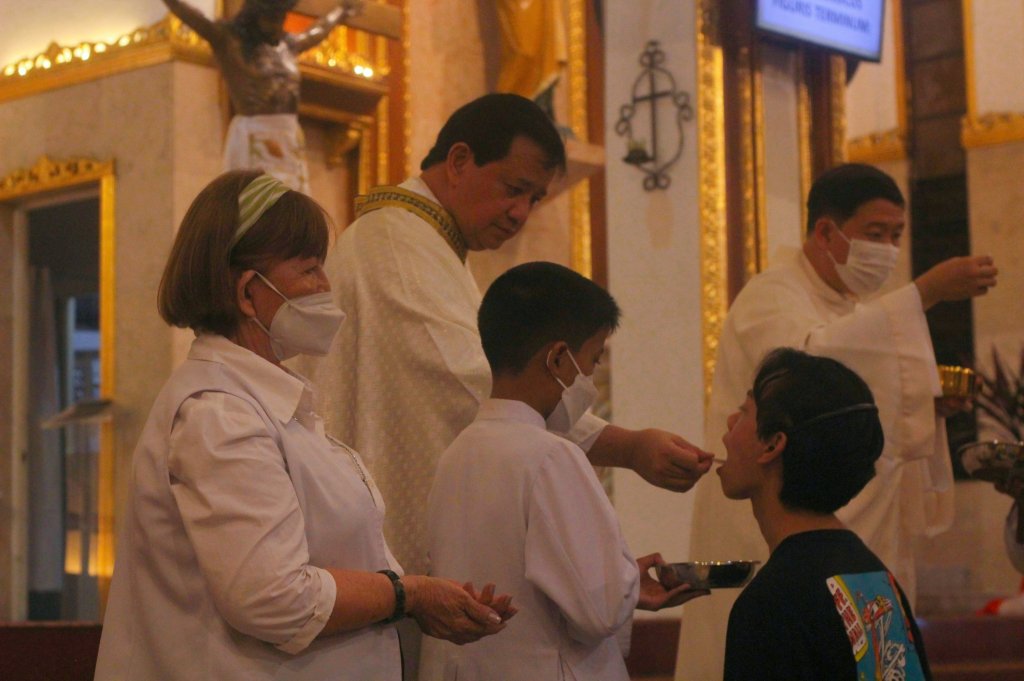
The most ancient practice of distributing Holy Communion was, with all probability, to give Communion to the faithful in the palm of the hand. The history of the liturgy, however, makes clear that rather early on a process took place to change this practice.
From the time of the Fathers of the Church, a tendency was born and consolidated whereby distribution of Holy Communion in the hand became more and more restricted in favor of distributing Holy Communion on the tongue. The motivation for this practice is two-fold:
a) first, to avoid, as much as possible, the dropping of Eucharistic particles;
b) second, to increase among the faithful devotion to the Real Presence of Christ in the Sacrament of the Eucharist.
Saint Thomas Aquinas also refers to the practice of receiving Holy Communion only on the tongue. He affirms that touching the Body of the Lord is proper only to the ordained priest.
Therefore, for various reasons, among which the Angelic Doctor cites respect for the Sacrament, he writes: “. . . out of reverence towards this Sacrament, nothing touches it, but what is consecrated; hence the corporal and the chalice are consecrated, and likewise the priest’s hands, for touching this Sacrament. Hence, it is not lawful for anyone else to touch it except from necessity, for instance, if it were to fall upon the ground, or else in some other case of urgency” (Summa Theologiae, III, 82, 3).
Over the centuries the Church has always characterized the moment of Holy Communion with sacredness and the greatest respect, forcing herself constantly to develop to the best of her ability external signs that would promote understanding of this great sacramental mystery. In her loving and pastoral solicitude the Church has made sure that the faithful receive Holy Communion having the right interior dispositions, among which dispositions stands out the need for the Faithful to comprehend and consider interiorly the Real Presence of Him Whom they are to receive. (See The Catechism of Pope Pius X, nn. 628 & 636). The Western Church has established kneeling as one of the signs of devotion appropriate to communicants. A celebrated saying of Saint Augustine, cited by Pope Benedict XVI in n. 66 of his Encyclical Sacramentum Caritatis, (“Sacrament of Love”), teaches: “No one eats that flesh without first adoring it; we should sin were we not to adore it” (Enarrationes in Psalmos 98, 9). Kneeling indicates and promotes the adoration necessary before receiving the Eucharistic Christ.

