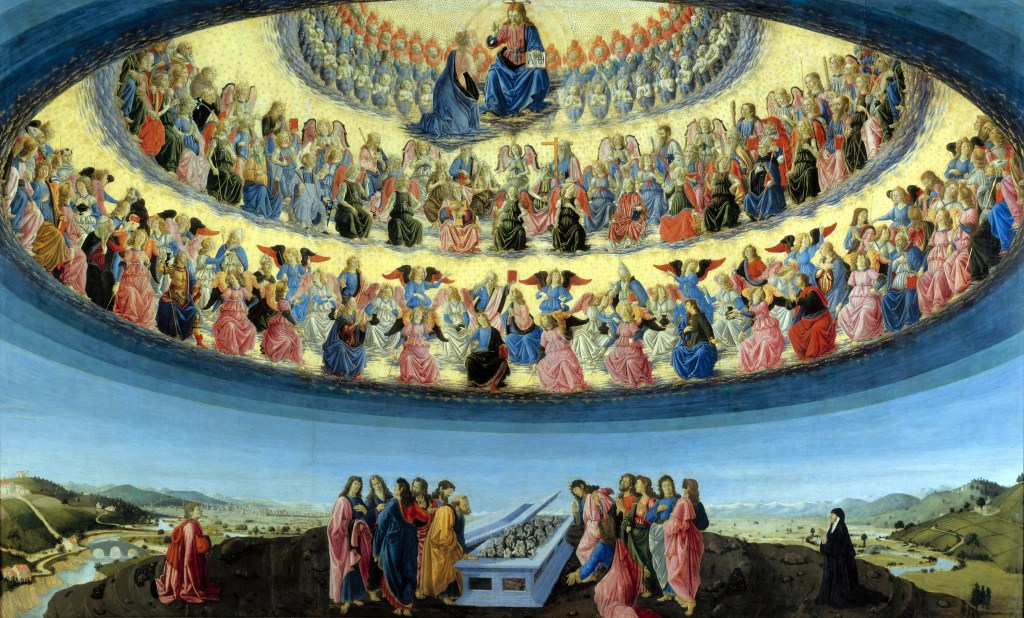
Catholic ecclesiology is the theological study of the Catholic Church, its nature and organisation, as described in revelation or in philosophy. Such study shows a progressive development over time. Here the focus is on the time leading into and since the Second Vatican Council (1962-1965).
In Christian theology, the Christian Church is traditionally divided into:
the Church Militant (Latin: Ecclesia militans), which consists of Christians on earth who struggle as soldiers of Christ against sin, the devil, and “the rulers of the world of this darkness, against the spirits of wickedness in the high places”;
the Church Penitent (Latin: Ecclesia poenitens), also called the Church Suffering (Latin: Ecclesia dolens) or the Church Expectant (Latin: Ecclesia expectans), which in the theology of certain churches, especially that of the Catholic Church, consists of those Christians currently in Purgatory; and
the Church Triumphant (Latin: Ecclesia triumphans), which consists of those who have the beatific vision and are in Heaven.
These divisions are known as the three states of the Church, especially within Catholic ecclesiology. These divisions are often discussed in the context of the doctrine of the communion of saints; although Christians may be physically separated from each other by the barrier of death, they nonetheless remain united to each other in one Church, and support each other in prayer.

The Church Triumphant
The term triumphant (Latin: triumphans), means “exulting, rejoicing exceedingly”, taken from a figurative usage of triumphus, originally designating the Roman triumph. Those who constitute the Church Triumphant rejoice eternally in the glory of God, to whom they are united in the beatific vision.
The Church Suffering
The term penitent (Latin: poenitens or paenitens means “repenting, being sorry”. Those who constitute the Church Penitent are in Purgatory to satisfy whatever portion of the temporal punishment due for their sins was not satisfied before death. They are in a process of purging their imperfections before entering heaven. It is held that all members of the Church Penitent will eventually join the Church Triumphant.
The alternate term suffering (Latin: dolens, lit. ‘grieving’) emphasizes the nature of souls’ experience in Purgatory; they are suffering the temporal consequences of their sins to redemptive effect. The other alternative, expectant (Latin: expectans or exspectans), emphasizes that the souls of Purgatory are awaiting expectantly the beatific vision of heaven.
The Church Militant
The term militant (Latin: militans) has a primary meaning of “being a soldier, performing military service”, but it acquired a secondary meaning of “serving, performing service, laboring”, with its root milito coming to mean “soldier of Christ or God” in Medieval Latin usage. The members of the Church Militant, i.e. those Christians on earth, are engaged in spiritual warfare against sin in order that, when they die, they might enter heaven and join the Church Triumphant. Failing that directly, those who believe in the existence of Purgatory hope to die in a state of grace and join the Church Penitent, to purify themselves of their imperfections and, ultimately, join the Church Triumphant.
The Catholic Church commemorates the Church Triumphant and the Church Penitent in its liturgy on two consecutive days: All Saints’ Day on November 1 (the Church Triumphant) and All Souls’ Day on November 2 (the Church Penitent).
These terms are not used in the Catechism of the Catholic Church, an authoritative summary of the teaching of the Catholic Church published in 1994. However, the teaching these terms represent is precisely restated, quoting Lumen gentium:
The three states of the Church. “When the Lord comes in glory, and all his angels with him, death will be no more and all things will be subject to him. But at the present time some of his disciples are pilgrims on earth. Others have died and are being purified, while still others are in glory, contemplating ‘in full light, God himself triune and one, exactly as he is’.”
Lumen Gentium


329 responses to “The Catholic Ecclesiology”
Catholic Ecclesiology refers to the study of the nature, mission, and structure of the Catholic Church. As a language model, I don’t have personal beliefs or opinions, but I can provide an overview of Catholic Ecclesiology.
Catholic Ecclesiology holds that the Church is a divinely established institution, founded by Jesus Christ and entrusted with the task of spreading the gospel message to all nations. The Church is seen as a visible, hierarchical institution with the Pope as its head, who serves as the Vicar of Christ on earth.
The Catholic Church also teaches that the Church is the Body of Christ, composed of all the baptized faithful, both living and dead, who are united in the Holy Spirit. The Church is also seen as a communion of local churches, each with its bishop and diocese, but united in faith and under the authority of the Pope.
One important aspect of Catholic Ecclesiology is the belief in the sacramental nature of the Church. The Church is seen as a source of grace, through which believers can receive the sacraments, including baptism, confirmation, Eucharist, reconciliation, anointing of the sick, holy orders, and marriage.
Another important concept in Catholic Ecclesiology is the idea of the Church as a pilgrim people on a journey towards God. This means that the Church is always in a state of reform and renewal, seeking to grow in holiness and to better fulfill its mission of evangelization and service to the world.
Overall, Catholic Ecclesiology provides a rich and complex understanding of the nature and mission of the Catholic Church. It emphasizes the importance of the Church as a divinely established institution, while also recognizing the vital role of the faithful in building up the Church and spreading the gospel message.
Chriz Anjelo R. Toledo
STEM 2207
LikeLike