On January 16, 1677, the Sacred Congregation of Rites issued a rescript addressing complaints from Don Diego Díaz de Escobar, the ceremoneer of Seville. Among the grievances was the practice of celebrating misas de aguinaldo with Gloria and Credo, using only one collect, and allowing laypeople to join the choir in singing festive carols that provoked laughter. The Congregation condemned these practices as abuses “repugnant to the rubrics” and ordered their complete abolition.
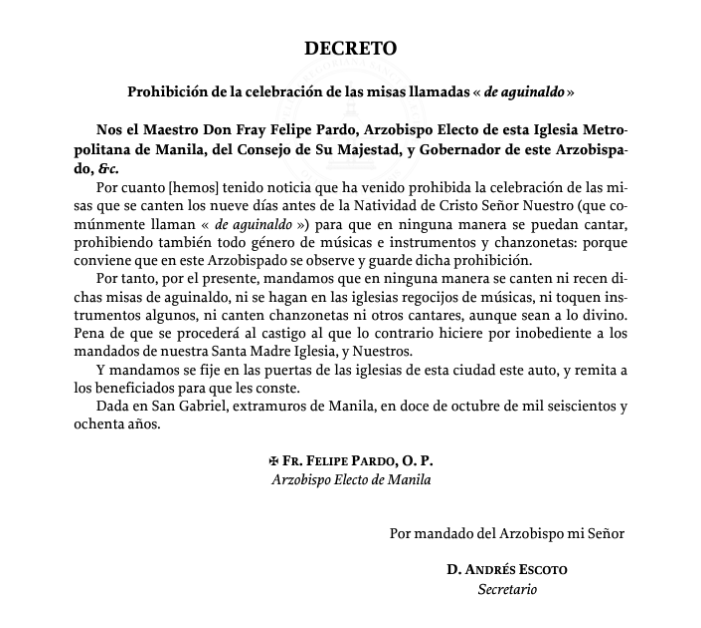
When this directive reached the Philippines, Archbishop-elect Fray Felipe Fernández de Pardo, a seasoned Dominican who had previously served as prior and provincial, wasted no time enforcing it. Named Archbishop of Manila by the King of Spain after a three-year vacancy, Fray Felipe reluctantly accepted the post in 1677. His appointment was confirmed by Pope Innocent XI in 1680, though he acted even before receiving the papal bull, issuing a decree banning both the singing of carols during the misa de aguinaldo and the misa de aguinaldo itself. He extended the ban to include all carols, even those with sacred themes, as well as both Sung and Low Masses.

The prohibition targeted three elements: music, instruments, and carols. Of particular interest is the term chanzoneta, which refers to light and festive compositions commonly sung during Christmas or other religious festivities. Distinct from the more refined villancico, the chanzoneta was livelier and less formal. Over time, the two forms merged, with the villancico remaining as the recognizable style today.
For example, the cheerful villancico “Rin, Rin” describes whimsical scenes such as a donkey carrying chocolate to Bethlehem and gypsies stealing the Christ Child’s nappies. In contrast, the solemn villancico “Niño Divino” meditates on the Child Jesus shivering in a manger, suffering not from cold but from humanity’s merciless indifference.
This historical incident underscores the need to safeguard the solemnity of the misa de aguinaldo. While music expresses the joy and anticipation of the season, it must remain within the bounds of sacred liturgy. Contemporary practices, such as using secular hymns like Christmas in Our Hearts during Communion, reflect a modern parallel to these abuses.
Gregorian chant offers a remedy, fostering moderation and preserving the dignity of the Mass. As stewards of the sacred liturgy, we are called to resist the temptation to prioritize external gaiety over interior reverence. By doing so, we honor our forebears’ legacy and maintain the integrity of the Church’s liturgical heritage.
Source: An attempt to suppress the misa de aguinaldo


Leave a comment