JOHN PAUL II
APOSTOLIC LETTER
SIMILE EST
TO THE VENERABLE SERVANT OF GOD PIER GIORGIO FRASSATI
THE HONORS OF BEATIFICATION ARE GRANTED
For perpetual memory. – “The kingdom of heaven is like a treasure hidden in a field, which a man found and hid; and for joy over it he goes and sells all that he has and buys that field” (Mt 13:44).
By divine grace made wise, the Venerable Servant of God Pier Giorgio Frassati placed his hope not in fleeting earthly things, but captivated by the love of Christ, he faithfully followed the precepts of the Gospel and testified to the beauty and joy of life in close union with Him, laboring to build His kingdom in the world.
He was born in Turin on the 6th day of April in the year 1901, to Alfredo Frassati and Adelaide de Ametis. On the same day he received Baptism, becoming a participant in the New Covenant people. In 1911, he approached for the first time the sacred table of the Eucharist, and in 1915 he received the sacrament of Confirmation. During his time as a student at the Social Institute, under the guidance of a certain Jesuit religious, he laid the foundations of his spirituality: love for the Eucharist, devotion to the Virgin Mary, industriousness, charity, and witness of faith in daily life.
In 1918, having entered the Polytechnic University of Turin to study mechanical engineering, he devoted himself particularly to architectural work for the benefit of the working class, which was in greater need.
During this time, he quickly made significant progress on the path of Christian perfection and attained great spiritual and human maturity. Strong in faith, ardent and diligent in charity, joyful and fearless in hope, assiduous in attending Mass and receiving the Sacraments, fervent in prayer, always ready for inconvenience, tireless and prudent in apostolic work, he became a shining example for laypeople sincerely devoted to their sanctification and to the world. He actively participated in the life of the Church and was a diligent member of numerous Catholic associations, among which are to be mentioned the Federation of Italian Catholic University Students, the Society of Saint Vincent de Paul, the Marian Congregation, the Nocturnal University Youth Adorers, and the Third Order of Dominicans. He also engaged in public and social life, courageously defending the rights of God, the Church, and humanity. Moved by the difficulties of the poor, he sought them out in their own homes to assist them both physically and spiritually. He was an example and a sure sign of equal life due to his full adherence to Christ, simplicity, humility, moral integrity, and his dedication to the cause of God and humanity: he understood, helped, confirmed in doing good, led to the Eucharist, which is the daily necessary food for him, and the bread of the brave, by which he is sustained in conflicts due to love of truth and justice. Piety towards the Blessed Virgin Mary was also a source of consolation and strength for him: this piety was expressed in daily recitation of the Rosary, in the Little Office of the Blessed Virgin and in sacred pilgrimages to her sanctuaries, especially those of Oropa and “Consolata” in Turin. As is the case with every true disciple of Christ, he did not lack hardships or unjust interpretations; but he bore all things in silence and with great inner peace.
He was about to receive the title of Doctor when a sudden case of poliomyelitis took his life on the 4th day of July in the year 1925, barely four days after its onset.
The reputation for holiness that he had acquired during his lifetime became evident from the large and spontaneous gathering of people at his funeral, and it quickly spread throughout Italy and abroad. He became an image of young Catholic men, especially among those attending universities, and many began to imitate his examples of virtue. Therefore, the Archbishop of Turin, in the year 1932, initiated the cause for canonization. Following the canonical procedures, the virtues were duly investigated, and on the 23rd day of October in the year 1987, before Us, the Decree was promulgated, by which We acknowledged that the young Pietro Giorgio Frassati exercised the theological, cardinal, and related virtues heroically. Subsequently, according to the norms, a miraculous event was considered, which took place in 1933, and was attributed to the prayer of the Venerable Servant of God.
On the 21st day of December in the year 1989, before Us, the Decree was issued concerning the miracle.
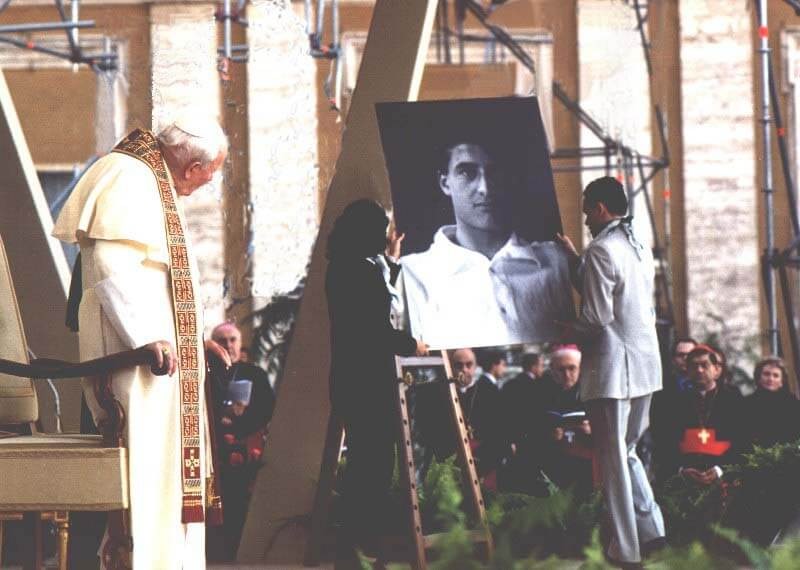
We then decided that the rites of beatification should be celebrated in Rome on the 20th day of May in the year 1990.
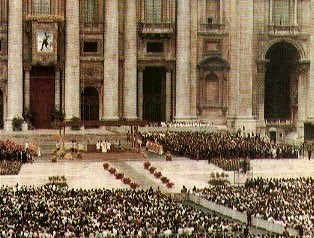
Today, therefore, at St. Peter’s Basilica in the Vatican, during the solemnities of the Mass, We have promulgated this formula: “We, fulfilling the wishes of Our Brother Giovanni Saldarini, Archbishop of Turin, as well as those of many other Brothers in the episcopate and of many Christ’s faithful, by the consultation of the Congregation for the Causes of Saints, by Our Apostolic Authority, grant the faculty that the Venerable Servant of God Pier Giorgio Frassati may henceforth be called Blessed, and that his feast may be celebrated annually on his birthday, that is, the 4th of July, in places and according to the norms legally established. In the name of the Father, and of the Son, and of the Holy Spirit.” What we have decreed in these Letters, We wish to be firm and valid now and in the future.
Given at Rome, at St. Peter’s, under the Fisherman’s Ring, on the 20th day of May, in the year 1990, in the twelfth year of Our Pontificate.
AUGUSTINE card. CASAROLI from the public Church negotiations
© Copyright 1990 – Libreria Editrice Vaticana
Read in Latin Text –


Leave a comment